Sector · Jewellery & accessories
Jewellery: real photography and batch catalogue
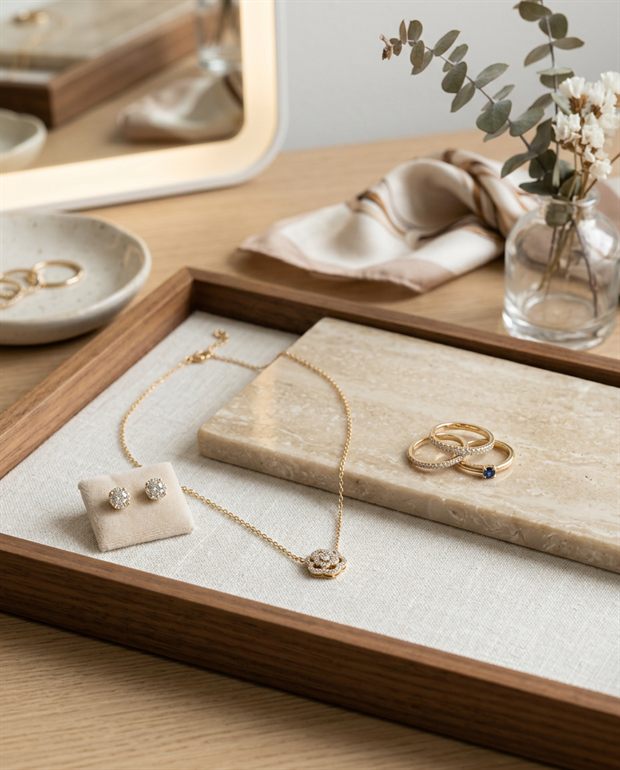
Jewellery is the least forgiving material there is. Every reflection depends on exactly where each light source sits, and one badly resolved highlight turns a quality piece into a cheap-looking product. That is why here we do not start with artificial intelligence: we start with the camera.
Why jewellery starts in the studio
A ring, an earring or a chain are surfaces with no colour of their own: they have reflection. What you see in the photo is the studio reflected in the metal. That is why the lighting does not light the piece, it draws it: it decides where the highlight sits, how far it stretches and which part stays in shadow so the volume reads.
That is physical control of light, and it is better solved with a camera than with a description. The same goes for stones: depth and refraction depend on the real position of the source relative to the cut.
What we resolve in session
- Metals: gold, silver, steel and plating, with controlled highlights and no blown whites.
- Stones and transparency, with real depth and no false halos.
- True scale of the piece, one of the leading causes of returns in jewellery.
- Macro of the finish, setting, clasp and hallmark.
- The piece worn, so proportion and drape are understood.
And from there, the whole catalogue
Once the real shot exists with the approved lighting standard, that image becomes the basis of the batch. Variants of the same piece — another metal, another stone, another size — plus campaign backgrounds, per-channel crops and context scenes are produced inheriting that pattern, without setting up the still-life table again every time.
That is the exact point where generative production adds value in jewellery: not by replacing photography, but by multiplying it.
Accessories and add-ons
Eyewear, watches, bags and small leather goods share the reflection problem and add the scale problem. They are handled the same way: a reference session to establish how the material behaves, and a batch to cover the volume of SKUs and variants.
How to start
With jewellery the usual route is to bring or ship two or three representative pieces — one metal, one stone, one finish — and settle the standard there. With that approved, the rest of the catalogue no longer carries any uncertainty.
Questions about jewellery and small pieces
Can jewellery be generated with AI?
The variants and the scenes, yes, but the source shot is better photographed. In jewellery what you see is the studio reflected in the metal, and that control is physical. We photograph one real reference and produce the rest of the batch from there.
Do I have to send the pieces?
With jewellery, yes: it is one of the cases where we ask for the physical product, along with technical fabrics and metallic finishes. Two or three representative pieces are enough to set the standard for the whole catalogue.
How do you show the real scale of a piece?
With images of the piece worn and with reference cues in the shot itself. It matters: badly communicated scale is one of the leading causes of returns in online jewellery.
Does it work for eyewear, watches and bags?
Yes. They share the reflection problem and the scale problem, and they are handled with the same method: a reference session to establish how the material behaves, and batch production to cover the volume.
Send us a piece and we will look at it for real.
With jewellery the pilot batch is especially useful: one reference is photographed, the lighting standard is approved, and from there you decide how much catalogue to produce.