Service · Virtual models
AI-generated virtual models
A shoot with a model means casting, an agency, a studio, a crew, a fixed date and an image licence that expires. A virtual model removes all six and keeps the only thing the listing cares about: the garment worn, clearly seen, under the same light as the rest of the catalogue.
What a virtual model actually is
It is a person who does not exist. Not a digital mannequin and not a composite over a stock photo: a fully generated photorealistic figure, with its own features, skin, hair and posture, on which your garment is placed respecting how the fabric falls, where it tensions and how the seam behaves.
Because the person does not exist, there is no agency, no rights agreement and no licence expiry. The image is yours and you can use it indefinitely, on any channel, without renegotiating anything in two years' time.
What you can vary
- Age and build, so the casting looks like your actual customer rather than a generic catalogue.
- Poses: listing front, side, back, full body and detail.
- Setting: neutral studio background or outdoor context, with the same garment and the same model.
- Continuity: the same model across a whole collection, or a different cast per product line.
Studio and street, with the same cast
A catalogue usually needs two registers: the clean listing image, which sells the product, and the context image, which sells the brand. Booking them separately means two sessions, two days and, almost always, two different models. Here it is the same person in both places, because the person is a parameter and not a diary.
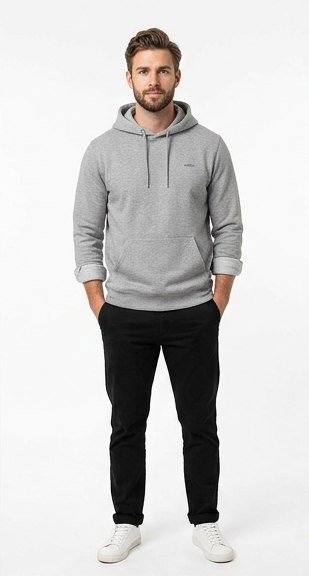
Listing register
Neutral background, studio light, repeatable framing. This is the image that goes on the listing and on marketplaces.
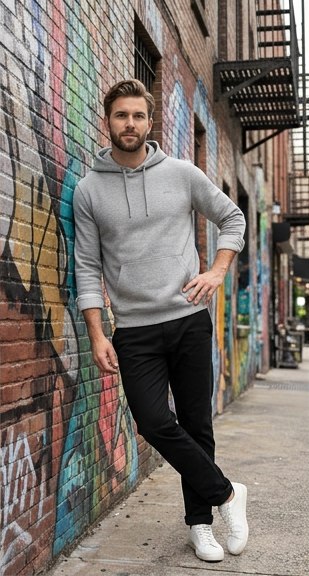
Campaign register
The same model outdoors or in a scene. For category pages, newsletters, social and paid media.
Where the honest limit is
Virtual models work very well with clothing, footwear, accessories and add-ons. Where care is needed is with materials that behave in optically complex ways: jewellery with reflections, sheer textiles, shiny technical fabrics or metallic finishes.
In those cases we do not force the tool. We photograph the piece for real in our Barcelona studio and use that shot as the basis of the batch, which is the route that gives the best result. Saying so up front avoids this industry's classic problem: promising that AI solves everything and delivering a catalogue that has to be redone.
Legality and labelling
Selling with AI-generated models is legal provided two conditions hold: the image must not mislead about the real product you are selling, and the generated content must be properly identified.
We deliver everything labelled in line with European transparency rules and give you the specific guidance for your own site. The garment in the image is your garment: what is synthetic is the person, not the product.
Questions about virtual models
Is it legal to sell using AI-generated models?
Yes, provided two things hold: the image must not mislead about the real product you are selling, and the generated content must be properly identified. We deliver everything labelled and give you the guidance for your site. And because no real people are involved, there are no image rights to license and no expiry date: you can use the material indefinitely.
Can you tell the images are AI-generated?
In commercial terms, no. Quality control is what makes the difference: every image goes through human review checking true colour, proportions, logos, stitching and texture. What we always do is label the content as AI-generated, as European transparency rules require.
Can I use the same model across a whole collection?
Yes. The model is a production parameter, not a person with a diary, so it can be repeated across a whole collection, across several campaigns or over consecutive seasons. You can also run different casts per product line.
Does it work with any kind of garment?
It works very well with clothing, footwear, accessories and add-ons. With sheer textiles, shiny technical fabrics, jewellery and metallic finishes we prefer to photograph the real piece in the studio and use that shot as the basis for the batch, because material accuracy is non-negotiable.
Want to see your garment worn before deciding?
Send us a reference and we will return it on a virtual model with the art direction we propose. It is the same pilot batch as always: no commitment.